
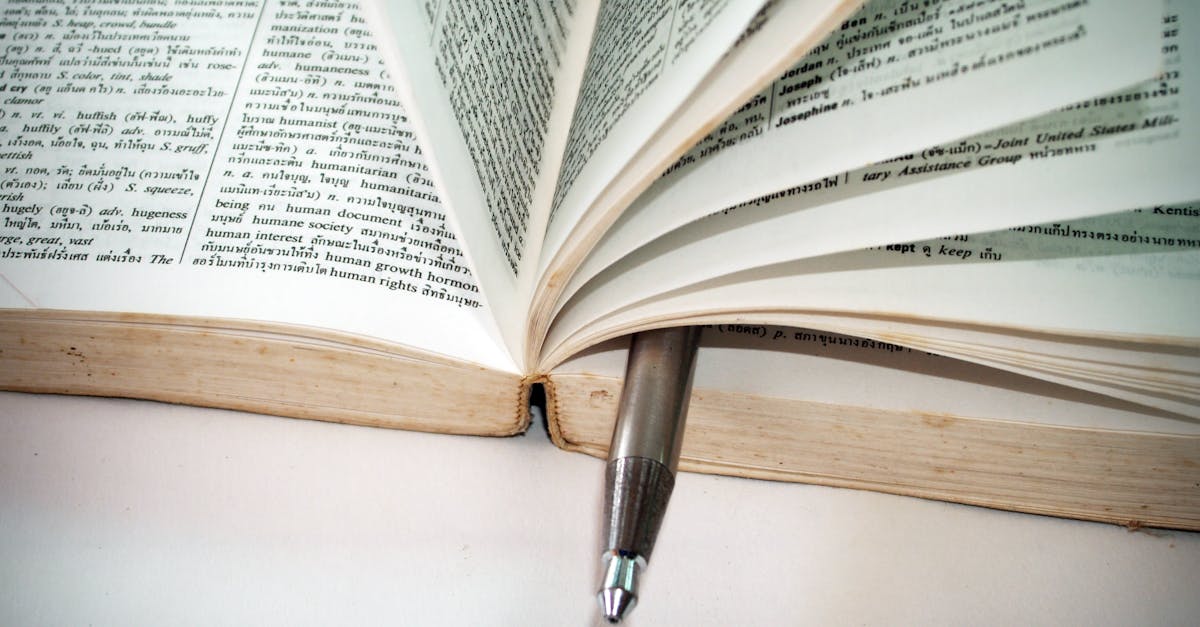
A thesaurus is one of the most valuable tools a writer can own—but it's also one of the most frequently misused. Used well, a thesaurus helps you find the perfect word to express your meaning with precision and elegance. Used poorly, it produces awkward, pretentious, or inaccurate prose that obscures rather than clarifies. The difference lies in understanding not just what a thesaurus contains, but how to evaluate the choices it offers.
This guide will teach you how to use a thesaurus as a thinking tool, not a crutch—one that deepens your understanding of the English language and genuinely improves your vocabulary over time.
What Is a Thesaurus?
A thesaurus is a reference book that groups words by meaning, providing lists of synonyms (words with similar meanings) and often antonyms (words with opposite meanings). Unlike a dictionary, which organizes words alphabetically and defines them, a thesaurus organizes words conceptually, helping you navigate from the word you have to the word you need.
The word "thesaurus" itself comes from the Greek word thēsauros, meaning "treasury" or "storehouse"—a fitting name for a collection that stores the wealth of the language. When you look up a word in a thesaurus, you're opening a treasury of alternatives, each with its own shade of meaning, tone, and personality.
A Brief History of the Thesaurus
The most famous thesaurus in the English language is Roget's Thesaurus, first published in 1852 by Peter Mark Roget, a British physician and lexicographer. Roget organized all of English vocabulary into a systematic taxonomy of concepts, grouping words by their relationships to one another. His original classification system divided all knowledge into six classes, further subdivided into sections and categories.
Roget's innovation was profound: instead of listing words alphabetically, he arranged them by meaning, creating a map of the language's semantic landscape. A reader could start with a vague concept—say, the idea of "fear"—and browse through increasingly specific terms until finding exactly the right word. This conceptual approach influenced the development of English reference works for the next two centuries.
Modern thesauruses come in various formats—from the traditional Roget-style conceptual arrangement to simple A-to-Z synonym dictionaries to digital tools integrated into word processors. Each format has strengths, but the underlying purpose remains the same: to help you find a better word.
Types of Thesauruses
Conceptual (Roget-Style)
These organize words by meaning rather than alphabetically. You browse through categories and subcategories to find related words. This format is excellent for brainstorming and exploring the full range of vocabulary related to a concept, but it can be slower to navigate.
Alphabetical (A-to-Z)
These list headwords alphabetically with synonyms underneath each entry. They're faster to use when you already have a word and want alternatives, but they don't show the broader landscape of related concepts.
Visual Thesauruses
Digital tools that display word relationships as interactive maps or webs, showing how synonyms, antonyms, and related words connect. These can be particularly helpful for visual learners and for understanding the distances between near-synonyms.
Integrated Thesaurus Tools
Most word processors and writing software include built-in thesaurus functions, typically accessible by right-clicking a word. These are convenient but usually provide shorter, less nuanced synonym lists than dedicated thesaurus references.
Why Synonyms Are Never Perfectly Equal
This is the single most important principle for using a thesaurus effectively: true synonyms are extraordinarily rare. Words listed together in a thesaurus share an area of meaning, but they almost always differ in some significant way—connotation, intensity, specificity, register, or grammatical behavior.
Consider these "synonyms" for "walk":
| Word | Differs From "Walk" Because... |
|---|---|
| Stroll | Implies a leisurely, relaxed pace |
| March | Implies a deliberate, rhythmic, military-style pace |
| Trudge | Implies difficulty, exhaustion, or reluctance |
| Saunter | Implies casual confidence or nonchalance |
| Amble | Implies a slow, easy, aimless pace |
| Stride | Implies long, purposeful steps |
| Shuffle | Implies dragging the feet, fatigue, or age |
All of these words mean "to move on foot," but each paints a completely different picture. Swapping one for another without understanding these differences can change your meaning entirely.
Understanding Connotation
Connotation is the emotional or associative meaning a word carries beyond its literal definition. Two words can have the same denotation (literal meaning) but very different connotations. "Slender," "thin," and "skinny" all describe someone who is not heavy, but "slender" sounds complimentary, "thin" sounds neutral, and "skinny" can sound critical.
When choosing among thesaurus options, always consider connotation. Ask yourself: Is this word positive, negative, or neutral? Does it carry associations I want? Will my reader react the way I intend? Understanding figurative language and connotation is essential for precise communication.
Understanding Register and Formality
Register refers to the level of formality appropriate to a given context. A thesaurus might list "commence," "begin," "start," and "kick off" as synonyms, but these words belong to different registers:
- Formal: commence, initiate, inaugurate
- Standard: begin, start
- Informal: kick off, get going, get the ball rolling
Using "commence" in a casual email sounds stiff; using "kick off" in a legal document sounds unprofessional. A thesaurus shows you options, but you must match the register to your audience and context.
Collocations and Natural Pairings
Words have preferred partners—combinations that sound natural to native speakers. We say "heavy rain," not "weighty rain." We say "make a decision," not "do a decision." These natural pairings are called collocations, and they're one of the trickiest aspects of choosing synonyms.
A thesaurus might tell you that "heavy" and "weighty" are synonyms, but they don't collocate with the same nouns. Before substituting a synonym, test it in the full phrase. Does "a weighty discussion" work? Yes—"weighty" collocates naturally with abstract nouns. Does "weighty rain" work? No—it sounds wrong because English speakers never pair those words.
Step-by-Step: Using a Thesaurus Correctly
- Identify the word you want to replace. Be clear about why you want a replacement. Is the word too vague? Too repetitive? Too formal? Wrong tone? Understanding the problem helps you evaluate solutions.
- Look it up in the thesaurus. Review the full list of synonyms. Don't grab the first option—read through them all to understand the range of choices.
- Narrow your options. Cross off words you don't recognize (you can't use a word accurately if you don't fully understand it). Cross off words that clearly don't fit the register, tone, or specificity you need.
- Check the dictionary. For any remaining candidates, look up their full definitions in a dictionary. Pay attention to usage notes, example sentences, and connotation markers.
- Test in context. Substitute the word into your sentence. Read the sentence aloud. Does it sound natural? Does it convey the exact meaning you intended? Does it work with the surrounding words?
- Verify collocations. Make sure the new word pairs naturally with the other words in your phrase. If you're unsure, search for the phrase in a corpus or on the web to see if native speakers actually use it.
Common Thesaurus Mistakes
The "Swallowed a Thesaurus" Effect
The most common misuse is replacing simple, clear words with obscure or pretentious alternatives to sound more impressive. "The conflagration was subsequently extinguished" is not better than "The fire was put out"—it's worse, because it obscures a simple idea behind unnecessarily complex vocabulary. Good writing uses precise words, not fancy ones.
Ignoring Connotation
Writing "the politician was notorious for her generosity" when you mean "famous" creates an unintended negative impression, because "notorious" connotes fame for something bad. Always verify the emotional coloring of a synonym.
Register Mismatch
Mixing formal and informal words in the same passage creates a jarring, inconsistent tone. If your essay uses "however" and "furthermore," switching to "plus" and "anyway" mid-paragraph is disorienting for the reader.
Using Unfamiliar Words
If you find a word in the thesaurus that you've never seen before, don't use it without thorough research. You might misunderstand its meaning, mispronounce it, or use it in an unnatural grammatical construction. A thesaurus is a tool for finding words you've encountered but can't recall, not for discovering words you've never known.
When Not to Use a Thesaurus
Sometimes the best word is the plain one. In the following situations, resist the urge to reach for a thesaurus:
- Technical writing: Precision matters more than variety. If "temperature" is the correct term, don't replace it with "warmth" for variety's sake.
- Instructions and procedures: Clarity is paramount. Use the same word consistently rather than confusing readers with synonyms.
- Dialogue: Characters should speak naturally. Replacing "said" with "ejaculated" or "opined" every other line sounds ridiculous.
- When repetition serves a purpose: Deliberate repetition can create emphasis, rhythm, or clarity. Don't break an effective rhetorical pattern for the sake of variety.
Using a Thesaurus to Improve Your Writing
Used well, a thesaurus helps you achieve three things in your writing: precision (choosing the word that most exactly conveys your meaning), variety (avoiding monotonous repetition), and tone (matching your language to your purpose and audience).
For precision, the thesaurus helps you move from a vague word to a specific one. Instead of "a nice day," you might find "a glorious day," "a pleasant day," "a balmy day," or "a sublime day"—each painting a distinctly different picture.
For variety, the thesaurus helps you avoid using the same word too frequently, which can make prose feel repetitive and monotonous. But use this sparingly—forced variation is worse than natural repetition.
For tone, the thesaurus helps you calibrate your language to your audience. An email to a colleague might call something "a great idea," while a formal report might call the same thing "a promising proposal." The thesaurus shows you the spectrum between casual and formal so you can position your language exactly where you want it.
The Thesaurus as a Vocabulary-Building Tool
Beyond its immediate practical use in writing, the thesaurus is a powerful tool for learning new words. Browsing synonym groups exposes you to words you might not encounter in ordinary reading. When you find an interesting word, look it up in the dictionary, add it to your word journal, and practice using it—the same process you'd use for any new word.
Over time, regular thesaurus use builds your awareness of the subtle differences between related words—the shades of meaning that separate "happy" from "elated" from "content" from "euphoric." This nuanced understanding is the hallmark of a sophisticated vocabulary and a skilled writer.
The thesaurus works best in partnership with other reference tools. Use it alongside a dictionary for definitions, an English grammar guide for correct usage, and resources on word roots and affixes for etymological insight. Together, these tools give you a complete picture of each word's identity and potential.