 Dictionary Wiki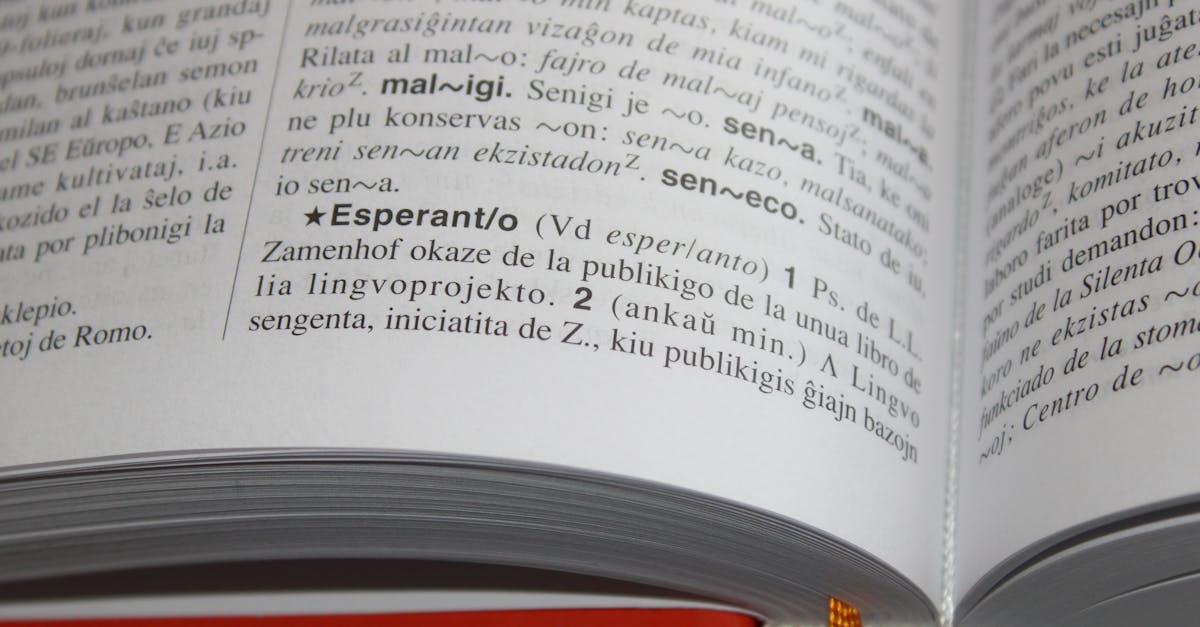
Most of the 7,000 languages spoken on Earth grew the way rivers grow — slowly, over generations, without anyone in charge. A smaller but steadily expanding group of languages did not. They were designed on purpose, often by a single person, for reasons that range from a utopian hope for world peace to the need for fictional elves to sound like fictional elves. These deliberate inventions, known collectively as constructed languages (or conlangs), shine a strange, clarifying light on what language actually is, how it behaves, and why human beings keep inventing new ones even when they already speak perfectly good ones.
What a Constructed Language Actually Is
A constructed language (conlang) is a language that a person or group sat down and designed on purpose, rather than one that emerged from centuries of being spoken. Conlangs have the same ingredients as natural languages — a phonology, a grammar, a vocabulary, and sometimes their own writing systems — but their origin is intentional rather than organic.
The urge to invent languages is surprisingly old. The twelfth-century German abbess Hildegard of Bingen drew up Lingua Ignota, a mystical language with more than a thousand invented words, for use in her religious community. The centuries since have produced hundreds more conlangs, driven by goals as mixed as international understanding, logical purity, aesthetic pleasure, and the need to populate imaginary worlds with plausible-sounding speakers.
Conlangs live on a wide spectrum. At one end, something like Esperanto has real speakers who use it every day to actually communicate. At the other, invented languages such as Tolkien's Elvish are pieces of art — objects to admire, analyse, and write poetry in rather than chat with. All of them share a useful property: because someone built them deliberately, they expose the machinery of language in a way that slow-grown tongues rarely do.
The Main Categories of Conlang
Auxiliary Languages (Auxlangs)
Auxlangs are proposed second languages for cross-border communication — a neutral option that doesn't belong to any one nation. Esperanto is the famous one, but hundreds of auxlangs have been floated over the years. Designers usually aim for three things: easy to learn, culturally neutral, and expressive enough to handle anything a real community would need to say.
Artistic Languages (Artlangs)
Artlangs are invented for artistic reasons — to sound beautiful, to flesh out a fictional culture, or simply because the inventor enjoyed the craft. Tolkien's Elvish varieties, the Na'vi of Avatar, and the Dothraki of Game of Thrones are the household names.
Engineered Languages (Engelangs)
Engelangs are built as experiments. Their designers want to test what language can or can't do, or what happens to thought when a language imposes unusual constraints. Lojban chases pure syntactic unambiguity; Toki Pona sees how small a vocabulary can get before communication breaks down.
Esperanto: The Runaway Success Story
In 1887, a Polish-Jewish ophthalmologist named L.L. Zamenhof published the first grammar of Esperanto — an easy-to-learn, politically neutral second language he hoped would ease tensions between peoples. The name Esperanto means "one who hopes," which doubled as Zamenhof's pen name.
Regularity is the project's defining principle. Nouns always end in -o, adjectives in -a, adverbs in -e. Verbs don't conjugate for person or number at all: mi legas ("I read"), vi legas ("you read"), ili legas ("they read"). There are no irregular verbs to memorise. The complete set of fundamental grammar rules — 16 of them — fits on a single side of paper.
Esperanto draws its vocabulary mainly from Romance and Germanic sources, supplemented by Slavic and Greek material. Word formation is agglutinative: you stick roots and affixes together to build new words from a small core vocabulary. The prefix mal- flips a word's meaning (bona → malbona, "bad"), and the suffix -ej- turns an action into the place where it happens (lerni, "to learn" → lernejo, "school").
A century and change after publication, Esperanto has somewhere between 100,000 and two million speakers (the estimates are famously slippery), a yearly world congress, a published literature that includes both original work and translations, and a small but real pool of native speakers — children raised bilingually with Esperanto as a home language. No other constructed language has come close to building that kind of living community.
The Rest of the Auxiliary Crowd
Volapük, created in 1879 by Johann Martin Schleyer — its name literally means "world language" — had a short blaze of popularity before Esperanto overtook it. Interlingua, launched in 1951 by the International Auxiliary Language Association, takes a different tack. Instead of inventing new material, it extracts the vocabulary already shared by the major European languages, producing a language that any speaker of a Romance language can half-read on first contact.
Ido, an 1907 reform of Esperanto, pulled away some Esperantists but never managed to replace its parent. Lingua Franca Nova (Elefen) is a more recent entry built on Romance vocabulary with a stripped-down grammar. Hundreds of other proposals have come and gone over the past 150 years; none has matched the longevity or community that Esperanto put together.
Languages Built for Art and Fiction
The twenty-first century has been a boom time for fictional languages, fuelled by film, television, and video games. Studios now hire professional conlangers to build linguistically plausible tongues for invented peoples, on the theory that a believable language makes an invented culture feel genuinely different rather than decorative.
Serious artistic language creation leans heavily on formal linguistics. A convincing conlang needs a phonology that hangs together, a grammar that isn't just scrambled English, vocabulary that mirrors its imagined culture, and, ideally, a plausible etymological history behind its words. The best artlangs feel exactly like natural languages that happen to belong to another world.
Tolkien, the Patron Saint of Conlanging
J.R.R. Tolkien was a professional philologist long before he was a novelist, and his conlangs — most famously Quenya and Sindarin, the two main Elvish varieties — were not side projects. "The invention of languages is the foundation," he once wrote. "The 'stories' were made rather to provide a world for the languages than the reverse." Middle-earth exists because Tolkien needed a continent where his languages could plausibly be spoken.
The depth of Tolkien's work still impresses linguists. Quenya, inspired by Finnish and Latin, is a case-marked language with a real phonology, a conjugation system, and thousands of words. Sindarin, modelled on Welsh, has its own sound changes and grammar. Both carry internal histories — Tolkien traced their descent from a common ancestor, Primitive Quendian, through millennia of fictional linguistic change.
He also built Khuzdul (Dwarvish, styled on Semitic languages), Black Speech for Mordor, and a set of scripts including the flowing Tengwar and the runic Cirth. His output became the benchmark that subsequent conlangers still measure themselves against.
Klingon
Klingon (tlhIngan Hol) is the work of linguist Marc Okrand, commissioned by the Star Trek franchise starting in 1984. Okrand's brief was to make the language sound genuinely alien, and he met it by packing Klingon with sounds English does not normally use — pharyngeal fricatives, retroflex affricates — and by ordering sentences as Object-Verb-Subject, the rarest basic word order attested in natural languages. The vocabulary leans hard into warrior-culture concepts.
A devoted if small community has grown up around it. The Klingon Language Institute runs a journal, maintains a dictionary, and has translated Hamlet, parts of the Bible, and other texts into Klingon. Only a handful of people speak it fluently, but the fact that a language engineered to be uncomfortable for human mouths can nonetheless attract real adherents says something striking about human motivation.
Conlangs on Today's Screens
Film and television have driven a burst of professional conlanging in the past two decades. Dothraki and High Valyrian, both built by David J. Peterson for HBO's Game of Thrones, each carry thousands of words and fully articulated grammars. Peterson has since designed languages for Dune, The Witcher, and many other productions.
Na'vi, built by linguist Paul Frommer for James Cameron's Avatar (2009), features an unusual tripartite alignment system and highly flexible word order — linguistically interesting even apart from its role in the film.
All this demand has professionalised the field. The Language Creation Society, founded in 2007, champions the art and craft of language creation and matches conlangers with studios. What was once a hobby with a small following is now a recognised niche with paying work.
Languages Designed to Think With
Some conlangs aim neither at communication nor at art. Their purpose is to stress-test logic or reshape how speakers approach ideas. Lojban, descended from an earlier project called Loglan, is built so that every sentence has exactly one grammatical parse — no ambiguity permitted. It serves as a laboratory for probing the Sapir-Whorf hypothesis with a language whose structure diverges sharply from anything natural.
Toki Pona, created in 2001 by Canadian linguist Sonja Lang, runs the opposite experiment. With a vocabulary of roughly 120 to 137 words, Toki Pona forces speakers to break complex ideas down into concrete primitives. "Computer" might come out as ilo sona ("knowledge tool"). Its minimalist, quasi-Daoist ethos has, against the odds, attracted a loyal community.
Historical entries include John Wilkins's Real Character of 1668, an attempt to name every concept systematically from a logical classification, and Gottfried Leibniz's dream of a characteristica universalis — a universal language of pure thought that he never completed.
What Conlangs Reveal About Natural Language
Conlangs are surprisingly useful to linguistics. They let researchers probe the outer limits of what a language can be: Can a working language get by without verbs? Without nouns? On 120 words? With a fifteen-way case system? Each functional conlang helps mark the line between what is genuinely impossible in human language and what is merely uncommon.
They also illuminate language acquisition. The small cohort of children raised with Esperanto as a native language turn out to introduce irregularities, slang, and innovations of their own — suggesting that messy, not-quite-rule-governed variation is a built-in part of the acquisition process rather than an artefact of inheritance.
Observing how conlangs change once communities start using them — new slang, drifting pronunciations, shifting idioms — confirms that the usual engines of language change don't care about origin stories. Give any language a living user base and it will start evolving.
The People Who Build Languages
The internet turned conlanging from a lonely pursuit into a worldwide hobby. Online forums, social platforms, YouTube channels, and dedicated sites connect thousands of creators; yearly conferences, podcasts, and the Language Creation Society raise the profile of the craft and keep it loosely organised.
The community pulls in linguists, novelists, illustrators, programmers, and plenty of pure amateurs. For a lot of them, building a language is the ultimate creative puzzle: it combines the logic of grammar, the aesthetics of sound, the scope of world-building, and the discipline of systematic design. At a moment when natural languages are disappearing at a grim rate, the conlanging scene offers an oddly hopeful counterweight — clear proof that the human appetite for inventing new ways to speak hasn't dimmed at all.
Look Up Any Word Instantly on Dictionary Wiki
Get definitions, pronunciation, etymology, synonyms & examples for 1,200,000+ words.
Search the Dictionary