
Introduction
When most people hear the word "dictionary," they picture a single type of book—a large volume with alphabetical word listings and definitions. In reality, the types of dictionaries available are remarkably diverse, each designed to serve different audiences, purposes, and needs. Understanding these different types of dictionaries helps you select the right tool for your specific situation, whether you are a student, writer, translator, researcher, or language learner.
The history of dictionaries shows a steady diversification from the earliest simple word lists to today's sophisticated digital platforms. Modern lexicography recognizes dozens of distinct dictionary types, each with its own conventions, strengths, and intended users. This comprehensive overview explores the most important types of dictionaries you are likely to encounter.
Monolingual Dictionaries
A monolingual dictionary explains words in a single language—the same language as the words being defined. When English speakers think of "a dictionary," they are typically thinking of a monolingual English dictionary. These dictionaries define English words using English definitions.
Monolingual dictionaries come in several sizes:
- Unabridged dictionaries aim to be as comprehensive as possible, containing 250,000 or more entries. Webster's Third New International Dictionary and the Oxford English Dictionary are unabridged dictionaries. They are essential for scholars and researchers but too large and expensive for everyday use.
- College or desk dictionaries are abridged versions containing 50,000–200,000 entries. Merriam-Webster's Collegiate Dictionary and the Oxford Dictionary of English fall into this category. They balance comprehensiveness with practicality and are the most widely used type of dictionary.
- Concise or pocket dictionaries contain fewer than 50,000 entries, focusing on the most essential vocabulary. They sacrifice detail for portability and quick reference.
Understanding what a dictionary is and how to use one effectively starts with knowing which type best suits your needs.
Bilingual and Multilingual Dictionaries
Bilingual dictionaries translate words between two languages. A Spanish-English dictionary, for example, lists Spanish words with their English equivalents and vice versa. These are among the oldest types of dictionaries—the ancient Sumerian-Akkadian word lists were essentially bilingual dictionaries.
Creating good bilingual dictionaries is challenging because languages rarely have perfect one-to-one word correspondences. The Japanese word wabi-sabi or the German word Schadenfreude have no single English equivalents. Bilingual dictionaries must navigate these gaps through explanations, multiple translations, and contextual examples. The challenge of untranslatable words is one of the most fascinating problems in bilingual lexicography.
Multilingual dictionaries cover three or more languages. They are less common because the complexity of managing multiple languages in a single volume is enormous, but they exist for specialized fields where international terminology needs standardization.
Learner's Dictionaries
Learner's dictionaries are specifically designed for people studying a language as a foreign or second language. They differ from standard monolingual dictionaries in several important ways:
- Controlled defining vocabulary: Definitions use only a limited set of common words (typically 2,000–3,000), ensuring that learners can understand the definitions without needing to look up additional words.
- More example sentences: Learners benefit from seeing words used in context, so learner's dictionaries include more examples than standard dictionaries.
- Detailed grammatical information: Entries include information about verb patterns, countable vs. uncountable nouns, and other grammatical features that non-native speakers need to know.
- Frequency information: Many learner's dictionaries indicate how common a word is, helping learners prioritize the most common English words.
- Cultural and usage notes: Additional guidance on pragmatic use, formal vs. informal registers, and cultural context.
The most prominent English learner's dictionaries are the Oxford Advanced Learner's Dictionary (OALD), the Longman Dictionary of Contemporary English (LDOCE), the Cambridge Advanced Learner's Dictionary (CALD), and the Collins COBUILD Advanced Learner's Dictionary.
Historical Dictionaries
Historical dictionaries trace the development of words through time, documenting when they first appeared, how their meanings have evolved, and providing dated quotations that illustrate each stage of a word's history. Unlike standard dictionaries, which describe words as they are used today, historical dictionaries tell the story of how each word has changed over centuries.
The Oxford English Dictionary is the preeminent historical dictionary of English. For each word, it provides dated citations—actual quotations from published texts—arranged chronologically, showing the word's first known use and its subsequent development. This makes it possible to trace phenomena like words that changed meaning over time.
Historical dictionaries are invaluable for scholars studying the history of the English language, literary researchers tracing word usage in historical texts, and anyone curious about how words have evolved.
Etymological Dictionaries
Etymological dictionaries focus specifically on word origins and historical development. While many standard dictionaries include brief etymological notes, etymological dictionaries provide far more detailed accounts of where words come from and how they have traveled across languages and centuries.
A good etymological dictionary traces a word back to its earliest reconstructed form, documents the languages it passed through, explains sound changes and meaning shifts along the way, and identifies cognates (related words) in other languages. For example, an etymological dictionary would show how the English word "mother" is related to the Latin mater, Greek mēter, Sanskrit mātár, and German Mutter, all descending from a common Proto-Indo-European root.
Notable etymological dictionaries include the Oxford Dictionary of English Etymology, the Chambers Dictionary of Etymology, and Douglas Harper's online Etymonline. These resources reveal the rich tapestry of influences that have shaped the English vocabulary—from Latin and Greek to French, Norse, and dozens of other languages.
Specialized and Technical Dictionaries
Specialized dictionaries focus on the vocabulary of particular fields, professions, or subject areas. They provide more detailed and technically precise definitions than a general dictionary can offer.
Examples of specialized dictionaries include:
- Medical dictionaries: Stedman's Medical Dictionary, Dorland's Illustrated Medical Dictionary
- Legal dictionaries: Black's Law Dictionary, Oxford Dictionary of Law
- Scientific dictionaries: Oxford Dictionary of Chemistry, McGraw-Hill Dictionary of Scientific and Technical Terms
- Computing dictionaries: Oxford Dictionary of Computing, various online tech glossaries
- Music dictionaries: The New Grove Dictionary of Music and Musicians
- Philosophical dictionaries: Oxford Dictionary of Philosophy
These dictionaries are essential for professionals and students who need precise understanding of specialized terminology. A general dictionary might define "tort" simply as "a wrongful act," while a legal dictionary provides the detailed legal definition with distinctions between different types of torts, references to relevant case law, and explanations of legal implications.
Thesauruses and Synonym Dictionaries
A thesaurus organizes words by meaning rather than alphabetically, listing groups of synonyms and antonyms. While technically distinct from dictionaries, thesauruses are closely related reference tools that complement dictionary use.
There are two main formats for thesauruses:
- Classified thesauruses organize words into hierarchical categories of meaning, from general to specific. Roget's Thesaurus uses this format, arranging all concepts into six main classes (Abstract Relations, Space, Matter, Intellect, Volition, and Affections) with numerous subdivisions.
- Alphabetical thesauruses list headwords alphabetically, with synonyms and antonyms under each entry. This format is easier to navigate but loses the conceptual organization that allows for broader exploration.
Understanding the difference between a dictionary and a thesaurus helps you use each tool at the right time.
Rhyming Dictionaries
Rhyming dictionaries organize words by their ending sounds, allowing poets, lyricists, and songwriters to quickly find words that rhyme. Entries are grouped so that all words ending in the same sound appear together—"bright," "flight," "knight," "might," "night," "right," "sight," and "tight" would all appear in the same section.
Good rhyming dictionaries distinguish between perfect rhymes (identical ending sounds), near rhymes or slant rhymes (similar but not identical endings), and sight rhymes (words that look like they should rhyme but do not, such as "cough" and "though"). Some also organize rhymes by number of syllables, making it easy to find rhymes that match a particular meter.
Visual and Picture Dictionaries
Visual dictionaries use illustrations and photographs to define words, grouping related terms around labeled images. Rather than providing verbal definitions, they show you what words refer to. A page about the human body, for example, might feature a detailed anatomical illustration with labels pointing to each part.
Visual dictionaries are particularly valuable for concrete vocabulary—objects, animals, plants, tools, body parts, and architectural features. They are less useful for abstract concepts. They are excellent tools for language learners, children, and anyone working in fields where visual identification is important.
The DK Visual Dictionary series and the Oxford Picture Dictionary are well-known examples. Digital visual dictionaries can incorporate animations and interactive features that enhance the learning experience.
Pronunciation Dictionaries
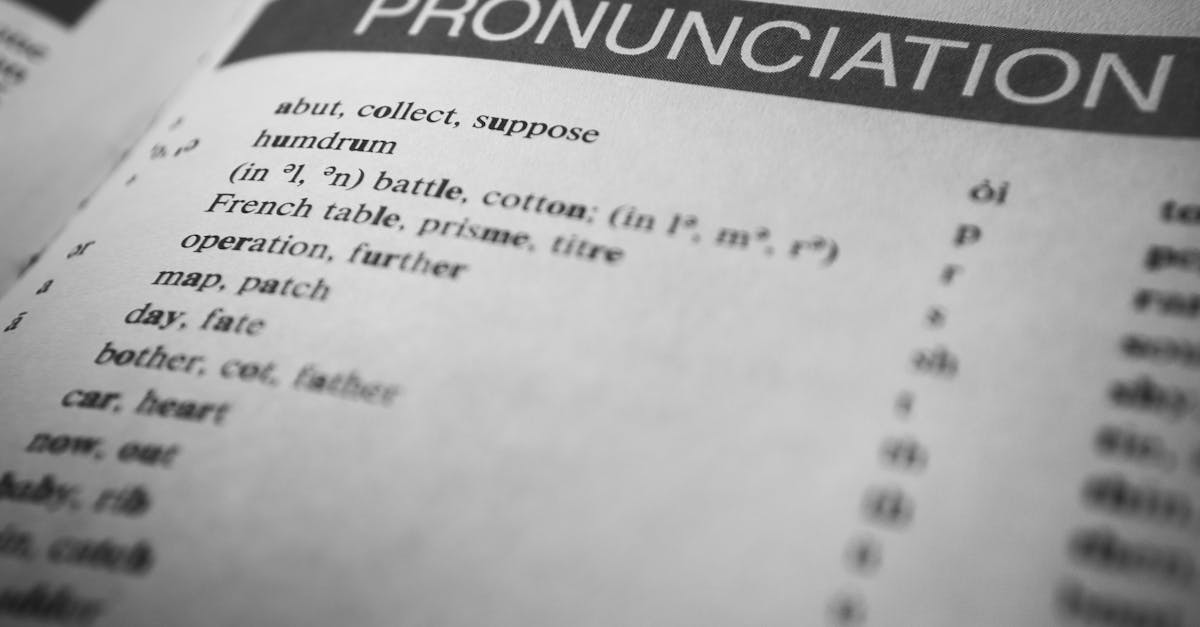
Pronunciation dictionaries focus specifically on how words are spoken. They provide detailed phonetic transcriptions, often in the International Phonetic Alphabet (IPA), along with information about stress patterns, variant pronunciations, and regional differences.
The Cambridge English Pronouncing Dictionary (originally by Daniel Jones) and Longman Pronunciation Dictionary (by J.C. Wells) are the standard reference works for English pronunciation. These dictionaries are invaluable for language learners, actors, broadcasters, and anyone working with the sounds of English.
Usage Dictionaries
Usage dictionaries address questions about correct, appropriate, or disputed language use. Rather than defining words, they discuss whether certain usages are standard, how contested forms are viewed by different audiences, and what guidelines apply in different contexts.
Merriam-Webster's Dictionary of English Usage, Fowler's Modern English Usage, and Garner's Modern English Usage are prominent examples. These works address questions like whether "hopefully" can properly modify a whole sentence, whether "literally" can be used for emphasis, and the fine distinctions between words like who and whom, that and which, or fewer and less.
Slang and Colloquial Dictionaries
Slang dictionaries document the informal, ephemeral, and often colorful vocabulary that standard dictionaries may not include or may only cover briefly. Slang and informal English represent a vibrant, constantly changing dimension of language that these specialized dictionaries capture.
Historical slang dictionaries, such as Green's Dictionary of Slang, document the development of slang vocabulary over centuries. Contemporary slang references like Urban Dictionary (a crowd-sourced online platform) track modern and emerging slang in real time, though with varying quality and reliability.
Reverse Dictionaries
Reverse dictionaries work in the opposite direction from standard dictionaries. Instead of looking up a word to find its meaning, you describe a meaning or concept, and the reverse dictionary suggests the word you are looking for. This is invaluable when you have a "tip of the tongue" moment—you know exactly what you want to say but cannot recall the word.
For example, if you search a reverse dictionary for "fear of heights," it would return "acrophobia." If you searched for "a word meaning to walk in a slow, relaxed way," it might suggest "stroll," "saunter," or "amble."
Digital and Online Dictionaries
Digital dictionaries represent the most significant recent development among all types of dictionaries. Online dictionaries offer advantages that print editions cannot match: instant search, audio pronunciation, dynamic updates, hyperlinked cross-references, and integration with other tools.
Many digital dictionaries combine multiple dictionary types in a single platform. Merriam-Webster's website, for example, includes a general dictionary, a thesaurus, a medical dictionary, and a legal dictionary, all searchable from a single search box. This convergence of types reflects the flexibility of digital media.
Collaborative dictionaries like Wiktionary represent a new model entirely—community-created, freely available, and covering hundreds of languages. While quality control is a challenge, the breadth and speed of coverage often surpass traditional dictionaries.
Choosing the Right Type of Dictionary
With so many types of dictionaries available, choosing the right one depends on your specific needs:
- For everyday word lookup: A general monolingual dictionary (Merriam-Webster, Oxford)
- For learning English as a second language: A learner's dictionary (OALD, LDOCE, CALD)
- For translation: A bilingual dictionary specific to your language pair
- For finding the right word: A thesaurus (Roget's, or an integrated online thesaurus)
- For professional terminology: A specialized dictionary for your field
- For word origins: An etymological dictionary
- For pronunciation: A pronunciation dictionary or an online dictionary with audio
- For writing and style questions: A usage dictionary
- For historical research: A historical dictionary (OED)
In practice, most people benefit from having access to several types of dictionaries. Fortunately, the digital age has made this easier than ever—many of the best dictionaries in each category are freely available online, and a single vocabulary building session might involve consulting three or four different types.